
UK Student Visa Requirements 2026 for International Students: Complete Step-by-Step Guide
edubeatsworld.com
5/25/2026
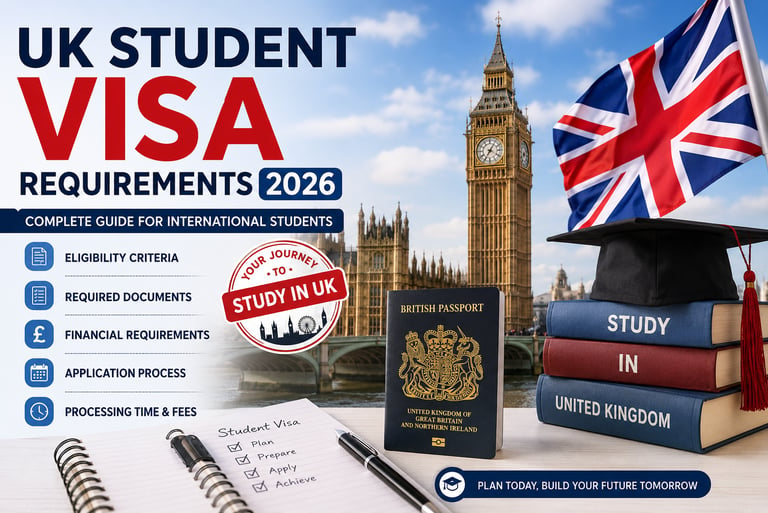
Studying in the United Kingdom continues to remain one of the biggest dreams for International students because of its globally recognized universities, strong academic reputation, multicultural environment, and excellent career opportunities. Every year, thousands of students choose the UK for undergraduate, postgraduate, diploma, and research programs.
However, securing admission alone is not enough. International students must also successfully complete the UK Student Visa process before travelling. Many students become confused about visa rules, financial requirements, documents, and application procedures because immigration guidelines can sometimes appear complicated.
This detailed guide explains the UK Student Visa Requirements 2026 for international students in a clear and easy-to-understand manner. From eligibility criteria and required documents to financial proof, visa interviews, processing times, latest immigration updates, and common mistakes, this article covers everything students need to know before applying.
(Students planning to study abroad in Europe should also understand country-specific financial requirements. For example, Germany requires international students to maintain a blocked account for visa purposes. You can read our detailed guide on Germany Blocked Account 2026: Step-by-Step Guide + Cheapest Provider for a complete explanation of blocked account rules, providers, and financial procedures.)
What is a UK Student Visa?
Official UK Government Student Visa Portal: https://www.gov.uk/student-visa
A UK Student Visa is an official Immigration permission that allows International students to live and study in the United Kingdom for the duration of their academic program. Earlier known as the Tier 4 Student Visa, this visa is mandatory for most students enrolling in long-term educational programs in the UK.
The Visa is generally issued for:
Undergraduate degree programs
Postgraduate and Master’s courses
Foundation and pathway programs
Diploma courses
PhD and Research-based studies
In addition to studying, the UK Student Visa may also allow students to work part-time during studies and stay in the UK after graduation through the Graduate Route Visa.
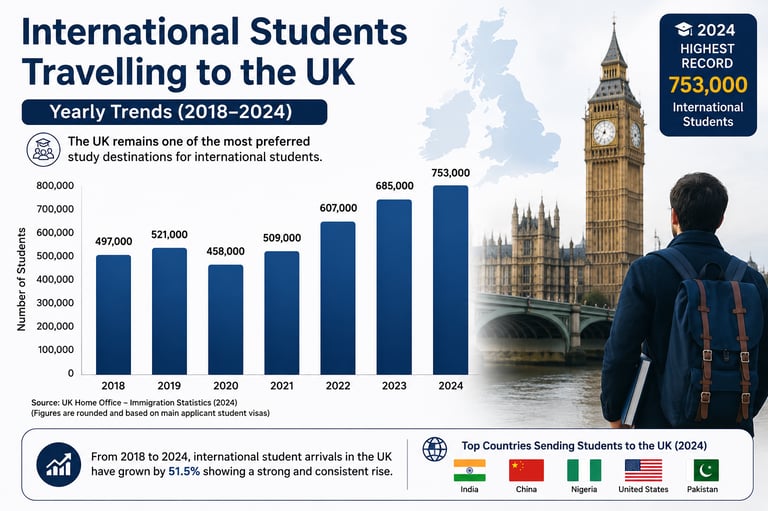
“International student arrivals in the UK have shown strong growth in recent years, reflecting the country’s continued popularity as a global education destination.”
Why Do International Students Prefer the UK?
Official Study UK Platform: https://study-uk.britishcouncil.org
Globally Recognized Universities
The UK is home to many world-famous universities known for academic excellence, research opportunities, and international recognition. Degrees from UK universities are respected globally and can improve long-term career prospects.
Shorter Course Duration
Compared to many countries, Undergraduate and Postgraduate programs in the UK are often shorter in duration.
For example:
Many Bachelor’s degrees are completed in 3 years
Most Master’s programs are completed in 1 year
This shorter duration helps students save both tuition fees and living expenses.
Multicultural Learning Environment
Students from different countries study in the UK, creating a highly diverse and multicultural atmosphere. Learners get opportunities to interact with people from various cultural backgrounds and build international networks.
Post-Study Work Opportunities
The UK Graduate Route allows eligible graduates to remain in the country after graduation to search for employment and gain valuable international work experience.
(Many international students compare study destinations such as the UK, USA, Canada, and Germany before making a final decision. If you are also considering the United States, explore our detailed guide on US F1 Visa Process 2026: Step-by-Step Guide for International Students.)
Latest UK Student Visa Changes in 2026
International students planning to study in the UK should remain updated regarding recent immigration policy changes.
Dependant Visa Restrictions
The UK government has introduced stricter rules regarding dependants for international students.
In most cases:
Students enrolled in taught Master’s programs cannot bring dependants
Dependants are generally permitted mainly for:
PhD students
Research-based Postgraduate students
Government-sponsored students
Applicants should always verify the latest dependant rules directly through official UK government guidance.
eVisa and Digital Immigration Status
The UK government is gradually shifting toward digital immigration records known as eVisas.
Some students may receive digital immigration status instead of physical BRP cards. Students should regularly check official UKVI updates regarding:
eVisa activation
Online immigration records
BRP collection requirements
Digital immigration verification procedures
Increased Financial Scrutiny
UK visa authorities continue to closely review financial documents, transaction history, source of funds, and sponsor credibility. Genuine and properly maintained financial records are extremely important for visa approval.
Who Must Apply for a UK Student Visa in 2026?
Official UK Visas and Immigration (UKVI) Website: https://www.gov.uk/government/organisations/uk-visas-and-immigration
Most students outside the UK and Ireland must apply for a UK Student Visa if they plan to study in the country for more than six months.
Students usually require this visa if:
They have received admission from a UKVI-approved institution
Their course duration exceeds 6 months
They are travelling from outside the UK
They are pursuing full-time academic studies
Students enrolling in short-term programs may require different visa categories depending on the course duration and study type.
(Students planning international education after school should carefully explore different career and higher education pathways before choosing a country or course. Read our detailed guide on All Options After Std XII to explore various academic and career opportunities available after school education.)
UK Student Visa Eligibility Criteria for International Students 2026
Before applying, students must meet several eligibility conditions established by UK immigration authorities.
1. Minimum Age Requirement
Applicants must generally be at least 16 years old to apply for a UK Student Visa. Students below 18 years of age may require additional parental consent and supporting documentation.
These documents may include:
Parent or guardian consent letters
Accommodation details
Travel authorization documents
Guardian arrangements in the UK
The UK government places strong importance on the safety and welfare of younger students.
2. Unconditional Offer from a UK Institution
Students must first secure admission from a recognized educational institution in the UK that holds a valid UKVI sponsor license.
After fulfilling all admission conditions, the university issues an unconditional offer letter confirming the student’s acceptance into the program.
Once the student accepts the offer and pays any required tuition deposit, the institution provides a CAS (Confirmation of Acceptance for Studies).
Universities may require partial tuition fee deposits before issuing the CAS letter. Deposit requirements vary depending on the institution.
The CAS is one of the most important documents required for visa processing because it contains:
Course details
Tuition fee information
Course duration
Sponsor institution information
Student reference details
Without a valid CAS number, students cannot complete their UK Student Visa application.
3. English Language Proficiency Requirement
Official British Council Website: https://www.britishcouncil.org
Since most courses in the UK are taught in English, applicants must demonstrate sufficient English language ability.
For degree-level programs, students usually require CEFR Level B2 proficiency.
Commonly accepted tests include:
IELTS Academic
TOEFL iBT
PTE Academic
Duolingo English Test (accepted by some universities)
Official IELTS Website: https://www.ielts.org
Official TOEFL Website: https://www.ets.org/toefl.html
Official PTE Academic Website: https://www.pearsonpte.com
Typical English Score Requirements
For foundation programs, students generally require an IELTS score between 5.0 and 5.5.
For undergraduate degree programs, universities commonly require an IELTS score between 6.0 and 6.5 depending on the institution and course.
For postgraduate programs, the required IELTS score is usually between 6.5 and 7.0, especially for competitive programs such as law, medicine, journalism, or business management.
Different universities may have different language requirements, so applicants should always verify the exact criteria directly with their chosen institution.
Documents Required for UK Student Visa 2026
Preparing proper documents is one of the most important parts of the UK Student Visa process. Incorrect or incomplete documents are among the leading reasons for visa refusal.
1. Valid Passport
Students must possess a valid passport covering the intended duration of stay in the UK.
The passport should:
Have sufficient blank pages
Match all application details correctly
Be in good physical condition
Not be near expiry
Applicants are advised to keep multiple physical and digital copies safely.
2. Confirmation of Acceptance for Studies (CAS)
The CAS is an electronic document issued by the university after admission confirmation.
The CAS includes:
Unique CAS reference number
Course start and end dates
Tuition fee details
Sponsor institution details
Students should carefully verify all details mentioned in the CAS because even minor mistakes may create problems during visa processing.
3. Academic Documents
Academic records help demonstrate that applicants are academically eligible for their chosen course.
These documents may include:
School certificates
Mark sheets
College transcripts
Degree certificates
Graduation proof
Students should maintain original copies as well as scanned digital versions for online uploads and verification purposes.
4. English Language Test Scores
Students must submit official proof of English language proficiency through accepted language examinations.
The minimum score requirement may vary depending on:
University
Course level
Subject specialization
Applicants should ensure their test scores remain valid throughout the admission and visa application process.
5. Financial Proof
Financial proof is one of the most carefully reviewed sections of the UK student visa application.
Applicants must demonstrate sufficient financial capability to cover:
Tuition fees
Living expenses
Accommodation costs
Daily expenses during their stay
Accepted financial documents may include:
Bank statements
Education loan sanction letters
Scholarship letters
Sponsorship affidavits
All financial documents should clearly display:
Account holder details
Bank logo and stamp
Transaction history
Required balance maintained properly
UK Student Visa Financial Requirements 2026
The UK government requires international students to maintain sufficient funds before applying for the visa.
Living Expenses Requirement for Students in London
Students studying in London must generally show:
£1,334 per month
For up to 9 months
This means students may need to demonstrate approximately £12,006 for living expenses alone, excluding tuition fees.
Living Expenses Requirement for Students Outside London
Students studying outside London must generally show:
£1,023 per month
For up to 9 months
This totals approximately £9,207 for living expenses.
Cities outside London are usually more affordable, making them popular among students seeking lower living costs while still receiving quality education.
The Important 28-Day Financial Rule
The UK student visa process follows a strict financial maintenance rule known as the “28-day rule.”
According to this rule:
The required funds must remain in the account continuously for at least 28 consecutive days
The final balance date should not be older than 31 days before the visa application date
If the balance falls below the required amount even for one single day, the visa application may be rejected.
Students should carefully monitor their bank accounts throughout the maintenance period.
(Different countries follow different financial systems for international students. While the UK requires proof of maintained funds, Canada often requires students to obtain a Guaranteed Investment Certificate (GIC). Read our detailed guide on GIC Canada 2026: Complete Guide for International Students to understand how the Canadian GIC system works)
Tuberculosis (TB) Test Certificate
Students from certain countries must undergo a Tuberculosis (TB) test before applying for the UK Student Visa.
The TB test must be completed at an approved clinic authorized by UK authorities.
The certificate generally remains valid for six months.
Students are advised to:
Schedule the test early
Carry valid passport identification
Keep multiple copies of the certificate
Immigration Health Surcharge (IHS)
Official UK Immigration Health Surcharge Portal: https://www.gov.uk/healthcare-immigration-application
Students must pay the Immigration Health Surcharge while submitting the visa application online.
The IHS allows students to access healthcare services under the UK’s National Health Service (NHS) during their stay.
After paying the surcharge, students may receive access to:
Doctor consultations
Emergency treatment
Hospital care
Healthcare support services
For many courses, the IHS may exceed £1,000 per year depending on course duration and visa validity.
Because the IHS can significantly affect the overall study abroad budget, applicants should include this expense in their financial planning.
ATAS Certificate (If Applicable)
Some postgraduate and research-based programs require students to obtain an ATAS certificate before visa approval.
ATAS stands for:
Academic Technology Approval Scheme
This requirement usually applies to advanced technical and research-related subjects such as:
Engineering
Artificial Intelligence
Biotechnology
Aerospace Research
Nuclear Physics
The approval process may take several weeks, so students should apply well in advance if required.
Step-by-Step UK Student Visa Application Process 2026
Step 1: Receive Admission Offer
Students must first apply to UK universities and secure an unconditional offer letter after meeting academic eligibility requirements.
Step 2: Obtain CAS Letter
After confirming admission and paying the required tuition deposit, the university issues the CAS.
Students should carefully review all information mentioned in the CAS before proceeding further.
Step 3: Prepare Financial Documents
Applicants must maintain the required funds correctly according to UK visa regulations and ensure compliance with the 28-day maintenance rule.
Step 4: Complete Online Visa Application
Students must carefully complete the UK Student Visa application form online.
Incorrect information related to passport details, finances, or personal information may delay processing or affect visa approval.
Step 5: Pay Visa Fee and IHS
Students must complete payment for:
UK Student Visa application fee
Immigration Health Surcharge (IHS)
The UK Student Visa application fee is generally around £490, although fees may change depending on updated government policies.
Payment receipts should be saved carefully for future reference.
Step 6: Book Biometrics Appointment
Official VFS Global Website: https://www.vfsglobal.com
Many students complete biometrics and visa submission procedures through authorized VFS Global visa centres.
Applicants must visit a visa application centre to submit:
Fingerprints
Photograph
Supporting documents
Students should carry all required original documents during the biometrics appointment.
Step 7: Wait for Visa Decision
After biometrics submission, standard processing generally takes around 3 weeks, although timelines may vary during peak admission seasons.
UK Student Visa Processing Time 2026
Understanding visa processing timelines is extremely important because delays may affect travel plans, accommodation bookings, and university reporting dates.
The processing time may vary depending on:
Country of application
Admission season
Number of applications
Visa service selected
Standard Processing
Most students receive a visa decision within approximately 3 weeks after biometrics submission.
Priority Visa Service
Some countries offer a Priority Visa Service where decisions may arrive within approximately 5 working days.
This service usually requires an additional fee.
Super Priority Visa Service
Certain locations may offer a Super Priority Visa Service where decisions may arrive within 24 hours after biometrics.
This service may not be available in every country and generally costs more than standard processing.
Approximate UK Student Visa Expenses for International Students
Students should prepare a proper budget before beginning the visa process.
Important expenses may include:
UK Student Visa application fee
Immigration Health Surcharge (IHS)
English language test fees
TB test charges
Education document translation charges
Biometrics and travel expenses
Priority visa service charges (if selected)
The exact total cost may vary depending on the student’s country, course duration, and selected visa services.
Common UK Student Visa Interview Questions
Some students may be required to attend a credibility interview during the visa process.
Visa officers may evaluate whether the applicant is a genuine student with legitimate academic intentions.
Common questions may include:
Why did you choose the UK?
Why did you select this university?
Why did you choose this course?
Who is sponsoring your education?
What are your future career plans?
Where will you stay in the UK?
Applicants should answer honestly according to the documents submitted with the visa application.
UK Student Visa Checklist for International Students
Before submitting the application, students should ensure they have prepared:
Valid passport
CAS from the university
Academic documents and transcripts
English language test scores
Financial proof documents
Education loan documents if applicable
Scholarship letters if applicable
TB test certificate if required
IHS payment confirmation
Completed online visa application form
Biometrics appointment confirmation
Keeping all documents organized can help avoid unnecessary delays.
Common Reasons for UK Student Visa Rejection
Many visa refusals occur because of avoidable mistakes.
Common rejection reasons include:
Insufficient financial proof
Incorrect bank statements
Fake or inconsistent documents
Invalid CAS details
Weak interview performance
Missing documents
Incorrect application information
Students should carefully verify every document before submission.
Common Mistakes International Students Should Avoid
Maintaining Incorrect Financial Balance
Failing to maintain the required funds correctly during the 28-day period is one of the most common reasons for rejection.
Applying Too Late
Delaying the visa process may create problems related to:
Biometrics appointments
Flight bookings
University reporting deadlines
Applying early is always advisable.
Giving Inconsistent Interview Answers
Students should answer all interview questions confidently and consistently according to their submitted documents.
Using Fake or Unverified Documents
Submitting fake financial proof or forged academic documents can lead to:
Visa refusal
Immigration bans
Future visa complications
Applicants should always provide genuine and verifiable information.
Can International Students Work While Studying in the UK?
Yes, many students are allowed to work part-time while studying in the UK.
Typical work conditions include:
Up to 20 hours per week during academic sessions
Full-time work during official holidays
Part-time employment may help students gain work experience and manage some living expenses. However, academic responsibilities should always remain the primary focus.
UK Graduate Route Visa After Studies
Official UK Graduate Visa Guidance: https://www.gov.uk/graduate-visa
The UK Graduate Route allows eligible international students to remain in the UK after completing their studies.
This route helps graduates:
Search for employment
Gain international work experience
Build professional networks
Explore long-term career opportunities
UK Graduate Route Stay Duration
Students completing a bachelor’s degree or master’s degree may usually remain in the UK for up to 2 years after graduation.
Students completing a PhD or doctoral degree may generally stay for up to 3 years after graduation.
(Students planning careers in technology, software development, artificial intelligence, or data science may also benefit from learning additional digital skills. Explore our guide on Best Online Platforms to Learn Coding for useful beginner-friendly learning resources.)
Frequently Asked Questions (FAQ)
When should students apply for a UK Student Visa?
Students can usually apply up to 6 months before the course begins. Applying early is strongly recommended.
Can parents sponsor a UK student visa?
Yes, parents can sponsor a student’s education and living expenses. Applicants may need to submit parent bank statements and sponsorship documents.
Is an education loan accepted as financial proof?
Yes, officially sanctioned education loans from recognized institutions are generally accepted.
Is IELTS compulsory for a UK Student Visa?
Not always. Some universities accept alternative English language tests such as PTE Academic or TOEFL.
Can students stay in the UK after graduation?
Yes, eligible graduates may remain in the UK under the Graduate Route Visa after completing their studies.
What happens if a UK student visa gets rejected?
If the visa is refused, students may correct the issues mentioned in the refusal letter and reapply with improved documentation.
Can students work full-time during semester breaks?
Yes, eligible students are generally allowed to work full-time during official university holidays.
Is CAS enough for visa approval?
No. Students must also satisfy financial, academic, English language, and immigration requirements.
How much bank balance is required for a UK student visa in 2026?
The required balance depends on tuition fees, study location, and living expenses. Students in London generally need higher financial proof compared to those studying outside London.
What is the minimum bank statement duration required?
The required funds must usually remain in the bank account continuously for at least 28 consecutive days before applying.
Disclaimer
This article titled “UK Student Visa Requirements 2026 for International Students: Complete Step-by-Step Guide” is intended solely for educational and informational purposes. The content has been prepared using publicly available information, official UK student visa guidance, study-abroad related updates, university resources, immigration policies, online research, and general educational information available at the time of publication.
UK student visa requirements, financial proof rules, tuition fee structures, living expense calculations, Immigration Health Surcharge (IHS) charges, visa application fees, English language requirements, CAS procedures, biometrics processes, TB test requirements, visa processing timelines, Graduate Route policies, dependant rules, eVisa procedures, work regulations, immigration rules, and documentation requirements may change periodically depending on updates issued by the UK Government, UK Visas and Immigration (UKVI), British Embassies/Consulates, VFS centres, universities, testing agencies, financial institutions, or immigration authorities.
Students are strongly advised to verify the latest information directly through official UK government websites, UKVI guidance, university international offices, visa application centres, and authorized institutions before making any educational, immigration, financial, or travel-related decisions.
Suggested Official Sources:
UK Government – Student Visa
UK Visas and Immigration (UKVI)
British Council
Study UK
VFS Global
Individual University International Admissions Offices
EduBeatsWorld is an independent educational blog and is not affiliated, associated, authorized, endorsed by, or officially connected with any UK university, British Embassy, UKVI, VFS centre, immigration authority, testing agency, financial institution, consultancy, or government body.
This article does not guarantee visa approval, university admission, scholarship approval, financial approval, Graduate Route eligibility, employment opportunities, immigration outcomes, or successful entry into the United Kingdom or any other country.
Final Thoughts
The UK Student Visa process for international students in 2026 may initially appear complicated, but proper planning and preparation can make the journey much smoother.
Students should begin preparations early, understand all eligibility requirements carefully, maintain proper financial records, and organize all supporting documents well in advance.
Studying in the United Kingdom offers access to globally respected universities, advanced research opportunities, multicultural experiences, and valuable international work exposure.
With genuine documentation, careful preparation, accurate financial planning, and awareness of the latest immigration updates, international students can successfully complete the visa process and begin an exciting educational journey in the UK.
contact@edubeatsworld.com
© 2024. All rights reserved.