
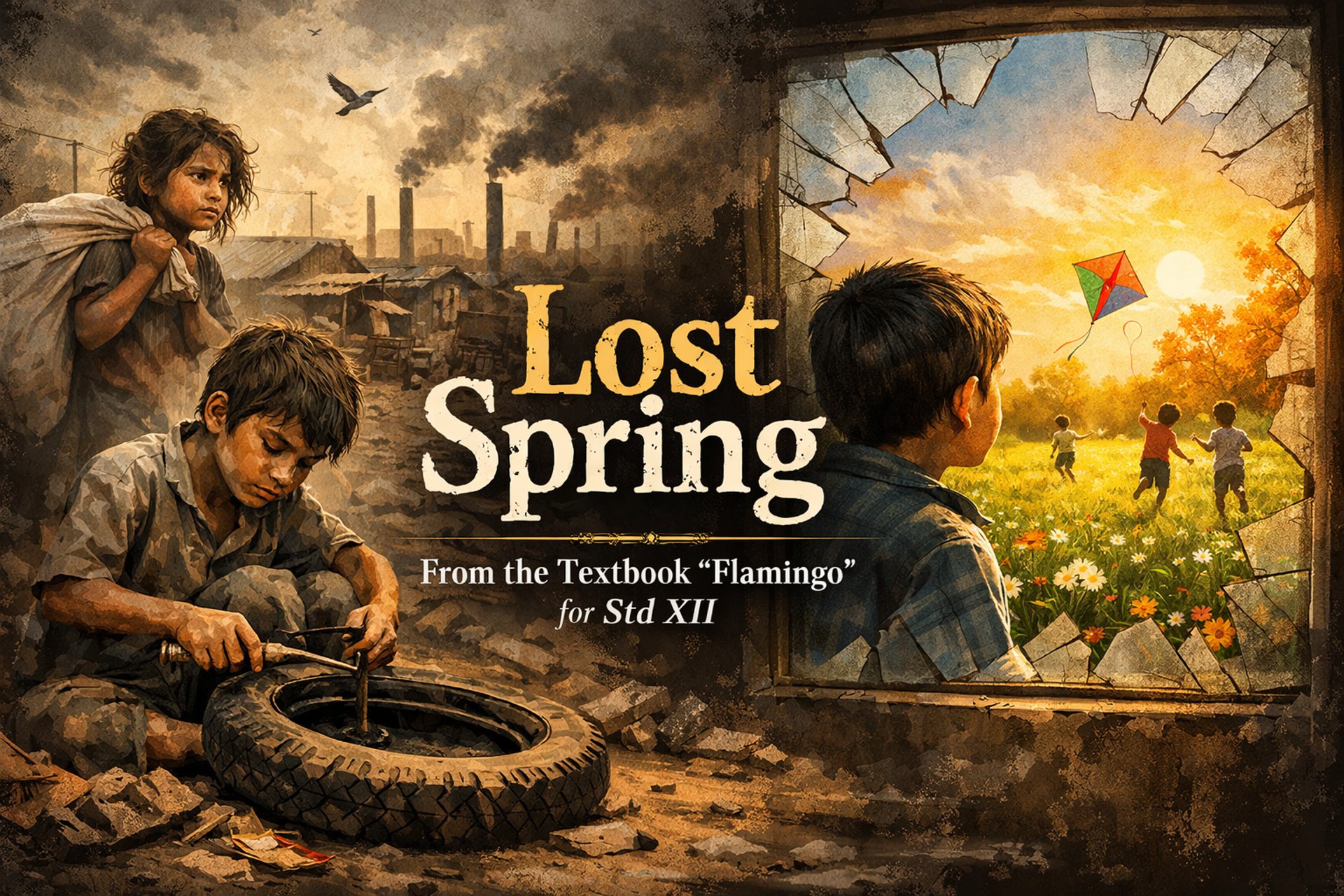
LOST SPRING -Anees Jung
EDUBEATSWORLD.COM
SUMMARY OF THE CHAPTER 'LOST SPRING
The chapter "Lost Spring" from the NCERT Std XII English textbook Flamingo examines the lives of impoverished children and their struggles to escape the cycles of poverty and labor. Through two moving stories, Anees Jung highlights the systemic oppression and deprivation that rob these children of their childhood and dreams. This chapter serves as a critical commentary on the social and economic conditions that perpetuate inequality and exploitation.
Introduction
The title "Lost Spring" serves as a metaphor for the lost childhoods of millions of children who are forced into labor and deprived of the chance to enjoy their formative years. Spring, a season often associated with growth, renewal, and happiness, is absent from their lives, which are instead dominated by the harsh reality of survival. Anees Jung explores this theme through two real-life stories: Saheb-e-Alam, a ragpicker from Seemapuri, and Mukesh, a boy working in the bangle-making industry of Firozabad.
💡 The theme of lost identity and suffering in this chapter is also seen in The Last Lesson, where language becomes a symbol of freedom and dignity.
Story 1: Saheb-e-Alam – A Ragpicker’s Life
The first part of the chapter introduces us to Saheb, a young boy who scavenges through the garbage in the slums of Seemapuri, located on the outskirts of Delhi. Saheb's family migrated from Dhaka, Bangladesh, due to extreme poverty and a lack of opportunities. They came to India in search of a better life, but their dreams of escaping poverty remain unfulfilled.
Saheb’s Daily Struggles
Saheb’s name, which translates to "Lord of the Universe," is ironic, as his life is far from the grandeur that his name suggests. He spends his days searching for "gold" in garbage dumps. For Saheb and the other ragpickers, garbage serves as a source of livelihood. Occasionally, they find something valuable—perhaps a coin or a discarded item—but mostly, it’s just a means of surviving.
Despite his circumstances, Saheb possesses a carefree spirit and an innocence that sharply contrasts with the harshness of his life. When asked why he does not attend school, he explains that there is no school nearby. Even when a school is eventually built, Saheb’s family cannot afford to send him there. Education, a fundamental right, remains out of reach for him and countless others like him.
Loss of Freedom
One day, Saheb takes a job at a tea stall. Although he now earns 800 rupees a month, he loses the freedom he once had as a ragpicker. Saheb realizes that working for someone else diminishes his sense of independence, and his dreams gradually fade into the background. Anees Jung poignantly captures this loss of freedom, symbolizing how poverty can imprison young lives.
Story 2: Mukesh – The Bangle Maker of Firozabad
The second part of the chapter shifts its focus to Mukesh, a boy from Firozabad, a city renowned for its glass-blowing and bangle-making industries. Families in Firozabad have been involved in this trade for generations, often living in extreme poverty and working under hazardous conditions.
A Life of Perpetual Struggle
Mukesh’s family is no exception to the struggles faced by many in the bangle industry. They live in a small, rundown house and work long hours to produce bangles. Unfortunately, the earnings from this labor-intensive work are minimal, barely enough to cover their basic needs. The bangle industry exploits its workers, keeping them trapped in a cycle of debt and poverty. The government's indifference and the lack of enforcement of labor laws only worsen their situation.
Hazardous Working Conditions
The glass-blowing furnaces present significant health risks. Children like Mukesh are exposed to high temperatures, toxic fumes, and poor lighting, all of which can damage their eyesight and overall health over time. The narrator describes the sight of boys with eyes "adjusted to the dark," highlighting both the literal and metaphorical blindness created by their circumstances. Despite the clear dangers associated with this trade, the families continue to engage in it because they feel they have no other options.
The Burden of Tradition
In Firozabad, bangle-making is not only a means of livelihood for many families, but it is also a deep-rooted tradition. The younger generation typically inherits this craft from their elders, who view it as their destiny. Efforts to pursue other opportunities are often discouraged, framed as a way to preserve culture and heritage. This oppressive social structure keeps workers in a subservient position towards their employers and lenders, perpetuating a cycle of exploitation.
Mukesh’s Aspirations
In the midst of this bleak situation, Mukesh stands out for his determination to break the cycle of poverty. Unlike his peers, he dreams of becoming a motor mechanic. His commitment to learning something new and pursuing his passion symbolizes hope and resilience. Mukesh's story serves as a reminder that, despite the challenges, aspirations can inspire change and challenge systemic oppression.
Themes in Lost Spring
Poverty and Exploitation: The chapter clearly depicts how poverty drives children into exploitative labor. Saheb and Mukesh are both victims of a socio-economic system that denies them basic rights and opportunities.
Loss of Innocence: The stories illustrate the early loss of childhood faced by these children. Instead of enjoying carefree lives, they carry burdens of responsibility and the struggle for survival.
Dreams and Aspirations: Despite their difficult circumstances, both Saheb and Mukesh have dreams. Saheb dreams of attending school, while Mukesh aspires to become a motor mechanic. Their dreams symbolize hope and the resilience of the human spirit.
Social Injustice: The chapter critiques the systemic injustice that perpetuates child labor and poverty. It questions the societal norms and government apathy that allow such conditions to persist.
Tradition vs. Change: In Mukesh’s story, the conflict between following traditional trade and exploring new opportunities is apparent. His wish to move away from the family business reflects a wider struggle for change.
Literary Devices
Anees Jung employs various literary devices to enrich the narrative.
Irony:
Saheb’s name, which means "Lord of the Universe," is ironic considering his life of poverty.
The bangle-making industry, linked to beauty and celebration, paradoxically brings suffering and hardship to its workers.
Imagery:
The vivid description of Seemapuri's slums and Firozabad's furnaces create a powerful visual impact.
The metaphor "gold in the garbage" symbolizes the small joys and hopes found amidst despair.
Symbolism:
Garbage symbolizes survival and shattered dreams for the ragpickers.
The bangles symbolize the traditional aspect of society.
Contrast:
Saheb's carefree attitude stands in stark contrast to the harsh reality of his life.
Mukesh's aspirations stand in stark contrast to his family's resignation to their fate.
Conclusion
Lost Spring is a poignant critique of the socio-economic conditions that deprive children of their rights and dignity. Through the stories of Saheb and Mukesh, Anees Jung highlights the harsh realities of child labor while underscoring the importance of education, freedom, and the pursuit of dreams. The chapter urges society to acknowledge and address the systemic inequalities that perpetuate poverty and exploitation, emphasizing the need for collective action to ensure a better future for all children.
ADDITIONAL QUESTIONS AND ANSWERS ON THE CHAPTER 'LOST SPRING'
[Acknowledgment: The questions and answers provided in this section are inspired by the themes and content of the NCERT English textbooks. For further reference, please consult the NCERT materials.]
1. What is the meaning of the title ‘Lost Spring’?
Answer:- ‘Lost Spring’ conveys the stories of children who have lost their childhood because of the grinding poverty and traditions that condemn these children to a life of exploitation.
2. Where would the author encounter Saheb every morning?
Answer:- The author would encounter Saheb every morning scrounging for gold in the garbage dumps of her neighbourhood, Seemapuri.
3. Where was Saheb from? Why did they leave their native place?
Answer:- Saheb was from Dhaka. They had left Dhaka because storms would destroy their fields and homes
4. What did the author promise Saheb?
Answer:- The author promised Saheb that she would start a school.
5. ‘Promises like mine abound in every corner of his bleak world.’ Explain.
Answer:- The author promised Saheb that she would start a school. The political leaders promise them various schemes and facilities before the elections but they are never fulfilled.
6. What is Saheb's full name and its meaning?
Answer:- The full name of Saheb is Saheb-e-Alam and it means lord of the universe.
7. To what does the author compare these ragpickers of Seemapuri?
Answer:- They are compared to an army of barefoot boys and morning birds
8. Why were the children not wearing chappals?
Answer:- The children were not wearing chappals because it has become their tradition to remain barefoot and because of the perpetual state of poverty.
9. Where is Seemapuri?
Answer:- Seemapuri is a place on the periphery of Delhi yet miles away from it.
10. Describe Seemapuri.
Answer:- In Seemapuri, the people live in structures of mud, with roofs of tin and tarpaulin, devoid of sewage, drainage, or running water. They live there without permits but with ration cards that get their names on voters’ lists and enable them to buy grain.
11. Describe Dhaka
Answer:- Dhaka is a beautiful land of green fields and rivers.
12. Garbage to them is gold. Explain.
Answer:- Garbage is very valuable for the survival of people in Seemapuri. People collect rags from the garbage. It has become their daily bread and a roof over their heads.
13. What is the meaning of Garbage for the children and elders?
Answer:- The meaning of Garbage is different for the children and elders. For the children, it is wrapped in wonder and for the elders, it is a means of survival.
14. Where was Saheb found by the author one winter morning?
Answer:- Saheb was found one winter morning at the neighbourhood club, watching two young men dressed in white playing tennis.
15. How did Saheb lose his freedom?
Answer:- Saheb worked for the milk booth, had to carry the heavy steel canister, and must reach on time. The plastic bag that he used to carry was light. While he would be picking rags on the garbage mound, he had the freedom to go there and return home whenever he wanted to but now he had to reach every day on time for work. He lost his freedom as he was no longer his own master but someone else’s servant.
16. What did Mukesh wish to become?
Ans: Mukesh wanted to become a motor mechanic.
17. Mukesh’s dream looms like a mirage. Explain.
Answer:- Mukesh is a poor boy who is uneducated so the author thinks that his dream may remain as a mirage and not turn into a reality.
18. Describe Firozabad.
Answer:- Firozabad is a dusty town famous for its bangles. It is the centre of India’s glass-blowing industry where families have spent generations working around furnaces, welding glass, and making bangles for all the women in the land.
19. In what conditions would the families make bangles?
Answer:- The families work in the glass furnaces with high temperatures, in dingy cells without air and light, next to lines of flames of flickering oil lamps, sit boys and girls with their fathers and mothers, welding pieces of coloured glass into circles of bangles, very often losing the brightness of their eyes.
20. In what conditions would people live in Firozabad?
Answer:- Firozabad is known for stinking lanes choked with garbage, past homes that remain hovels with crumbling walls, wobbly doors, no windows, crowded with families of humans and animals coexisting in a primeval state.
21. Describe the house of Mukesh.
Answer:- Mukesh’s house was a half-built shack which was in one part thatched with dead grass. There was a firewood stove on the floor over which sat a large vessel of sizzling spinach leaves and a frail young woman was cooking the evening meal for the whole family.
22. Mention the custom that was followed.
Answer:- When the older man entered the house, the daughter-in-law of the house gently withdrew behind the broken wall and brought her veil closer to her face. As custom demands, daughters-in-law must veil their faces before male elders.
23. What do you know about Mukesh’s elder brother?
Answer:- Mukesh’s elder brother was an impoverished bangle maker. Despite long years of hard labour, first as a tailor, then as a bangle maker, he had failed to renovate their house, and send his two sons to school. All he had managed to do was to teach them what he knew - the art of making bangles.
24. Mention the different colours of the bangles.
Answer:- The different colours of the bangles are - sunny gold, paddy green, royal blue, pink, purple, every colour born out of the seven colours of the rainbow.
25. What was done after the bangles were made?
Answer:- After the bangles were made, they are made to lie in mounds in unkempt yards, are piled on four-wheeled handcarts and are pushed by young men along the narrow lanes of the shanty town.
26. What is the sanctity of bangles?
Answer:- They symbolise an Indian woman’s suhaag, auspiciousness in marriage.
27. What cry rings from every house of Firozabad?
Answer:- The cry of not having money to do anything except carry on the business of making bangles, not even enough to eat, rings in every home. The young men echo the lament of their elders.
28. Why would the people not organise themselves into a cooperative in Firozabad?
Answer:- If they organise into a cooperative then they would be hauled up by the police, beaten and dragged to jail for doing something illegal.
29. Mention the two distinct worlds that are found in Firozabad.
Answer:- One of the family, caught in a web of poverty, burdened by the stigma of caste in which they are born, the other a vicious circle of the sahukars, the middlemen, the policemen, the keepers of law, the bureaucrats and the politicians.
30 Show that Mukesh’s dream is more practical than imaginary.
Answer:- Mukesh is practical minded and realistic. He dreams to become a motor mechanic. Even though he is poor, he knows that he would be able to fulfil it. He knows his ground reality. But to dream of flying airplanes is beyond his reach and so he doesn’t think about them.
31. Mention the hazards of working in the glass bangles industry?
Answer:- The workers become blind while soldering the glass pieces into bangles. The dust of the bangles is injurious to the eyes likewise the furnaces have a very high temperature.
32. How is Mukesh’s attitude to his situation different from that of his family?
Answer:- The family members of Mukesh believe that they are destined to work as bangle makers but Mukesh feels that he would go to a far away garage and learn to become a motor mechanic.
33. What could be some of the reasons for the migration of people from villages to cities?
Answer:- Some of the reasons for the migration of people from villages to cities are 1) Lack of job opportunities in the villages and 2) Lack of modern amenities.
34. Would you agree that promises made to poor children are rarely kept?
Answer:- The author promised Saheb that she would start a school but she did not really mean it. The government has made laws prohibiting child labour but there are more than 20,000 children working in bangles industry. It is because the government is unable to provide alternative employment, free education and other such facilities to these children that they remain helpless.
35. What forces conspire to keep the workers in the bangle industry of Firozabad in poverty?
Answer:- The forces that conspire to keep the workers in the bangle industry of Firozabad in poverty are that they find themselves in the clutches of the sahukars, the middlemen, the policemen, the keepers of the law, the bureaucrats and the politicians.
Answers to Queries:
36. What is the central idea of 'Lost Spring'?
Answer:- The central idea of 'Lost Spring' by Anees Jung addresses the exploitation of children living in poverty,, where their dreams and childhood are sacrificed for survival. The essay highlights the plight of two children, Saheb and Mukesh, who are trapped in a cycle of poverty and forced labor. It emphasizes the need for education and social reforms to break this vicious cycle and provide these children with a brighter future. The narrative also critiques societal apathy toward their struggles, shedding light on the systemic issues that perpetuate their dire situations.
37. What is the conclusion of 'Lost Spring'?
Answer:- The conclusion of Lost Spring emphasizes the urgent need to break the cycle of poverty and child labor that deprives children of their childhood and dreams. Anees Jung calls for societal awareness, education, and reforms to empower underprivileged children and help them escape their harsh realities. She emphasizes the importance of providing these children with opportunities to lead better lives, free from exploitation, and to achieve their aspirations. The narrative concludes on a hopeful note, calling for collective efforts to about change.
38. What are the literary devices found in 'Lost Spring'?
Answer:- The literary devices found in 'Lost Spring' are :-
1. Imagery: Landscapes are described vividly helping readers create mental pictures to visualize the setting and emotions.
2. Symbolism: Objects and scenarios symbolize deeper meanings like 'spring' symbolizes childhood and 'lost spring' symbolizes the loss of innocence.
3. Irony: The harsh reality of child labor is contrasted with the dreams of children, such as Saheb's name means 'lord of the universe' while he struggles with poverty.
4. Metaphor: Comparisons are used without using 'like' or 'as'. The impoverished life is considered a 'perpetual state of poverty.'
5. Repetition: Certain words are repeated to emphasize the plight of poor children, such as 'poverty' and 'dreams'.
6. Pathos: The author uses emotional appeal to evoke sympathy. The children's struggles and unfulfilled aspirations are described evoking pathos.
39. What is the theme of 'Lost Spring'?
Answer:- The theme of 'Lost Spring' by Anees Jung revolves around poverty, child labor, and the loss of childhood dreams. The essay highlights how children from impoverished backgrounds are trapped in a cycle of exploitation and denied basic rights like education, freedom, and a carefree childhood. It delves into the harsh realities faced by children like Saheb and Mukesh, showcasing their unfulfilled dreams and the systemic issues that perpetuate their suffering. The narrative also explores social injustice and inequality, emphasizing the need for awareness and reforms to break this cycle and provide these children with opportunities for a better future.
💡 Another inspiring story of overcoming challenges is found in Deep Water, where the author conquers his fear through determination.
Lost Spring – Anees Jung
(These questions are given within or at the end of the lesson on the English Test book for Std XII - Flamingo, NCERT)
[Answer the following questions in 30 to 40 words each]
1. What is Saheb looking for in the garbage dumps? Where is he and where has he come from?
Saheb is looking for coins and useful items in the garbage dumps, which he calls “gold.” He lives in Seemapuri, Delhi, and has migrated from Dhaka, Bangladesh, due to poverty and lack of opportunities.
2. What explanation does the author offer for the children not wearing footwear?
The author explains that the children are not wearing footwear as some families justify it as their tradition, but it is mainly an excuse to hide economic hardship, lack of basic necessities and perpetual state of poverty.
3. Is Saheb happy working at the tea stall? Explain.
Saheb is not happy working at the tea stall. Though he earns a regular wage and gets food, he has lost his freedom as he is no longer his own master but someone else’s servant. His carefree smile disappears, showing that work has burdened him.
4. What makes the city of Firozabad famous?
Firozabad is famous for its glass bangle industry. Families have been engaged in this craft for generations, producing bangles worn by women across India, making the city an important centre for traditional bangle-making.
5. Mention the hazards of working in the glass bangles industry.
Workers face extreme heat from furnaces, lack proper ventilation, and work in dark, cramped spaces. Many suffer from respiratory diseases, eye problems, and injuries, often losing eyesight due to continuous exposure to harmful conditions while welding and soldering the glass pieces into bangles.
6. How is Mukesh’s attitude to his situation different from that of his family?
Mukesh shows determination and hope, dreaming of becoming a motor mechanic. Unlike his family, who accept their fate in bangle-making, he dares to break tradition and seeks a better, independent future.
7. What could be some of the reasons for the migration of people from villages to cities?
People migrate due to poverty, lack of employment, natural disasters, and better opportunities in cities. Urban areas promise jobs, education, and improved living conditions, attracting villagers despite the harsh realities they often face.
8. Would you agree that promises made to poor children are rarely kept? Why does this happen in the text?
Yes, such promises are often false and made casually without intent to fulfil them. In the story, the author promised a school to Saheb but the author did not really mean it. The government also make laws prohibiting child labour and would provide free education and other such facilities to these children but these promises are not fulfilled. It reflects society’s habit of ignoring the real needs of poor children.
9. What forces conspire to keep the workers in the bangle industry of Firozabad in poverty?
The forces that conspire to keep the bangle workers of Firozabad in poverty are the middlemen, money lenders, the police, the bureaucrats and the politicians. The workers are trapped in a vicious circle of debt and tradition. They lack education which prevents them to improve their living conditions.
📚 Continue Learning
If Lost Spring made you think, explore more chapters and poems:
👉 Read The Last Lesson – Importance of language and identity
👉 Explore Deep Water – A journey of courage and confidence
👉 Discover Indigo – Gandhiji’s fight for justice
🎵 Poem Connection:
👉 An Elementary School Classroom in a Slum – A deep look into poverty and inequality
✍️ Practice Section:
👉 Letter Writing & Grammar
Keep learning with EduBeatsWorld!
contact@edubeatsworld.com
© 2024. All rights reserved.