
The Last Lesson
'The Last Lesson' is a touching story set up in the background of the Franco-Prussian War and shows how it affects the lives of the people of Alsace and Lorraine. .
edubeatsworld
Summary of the Lesson
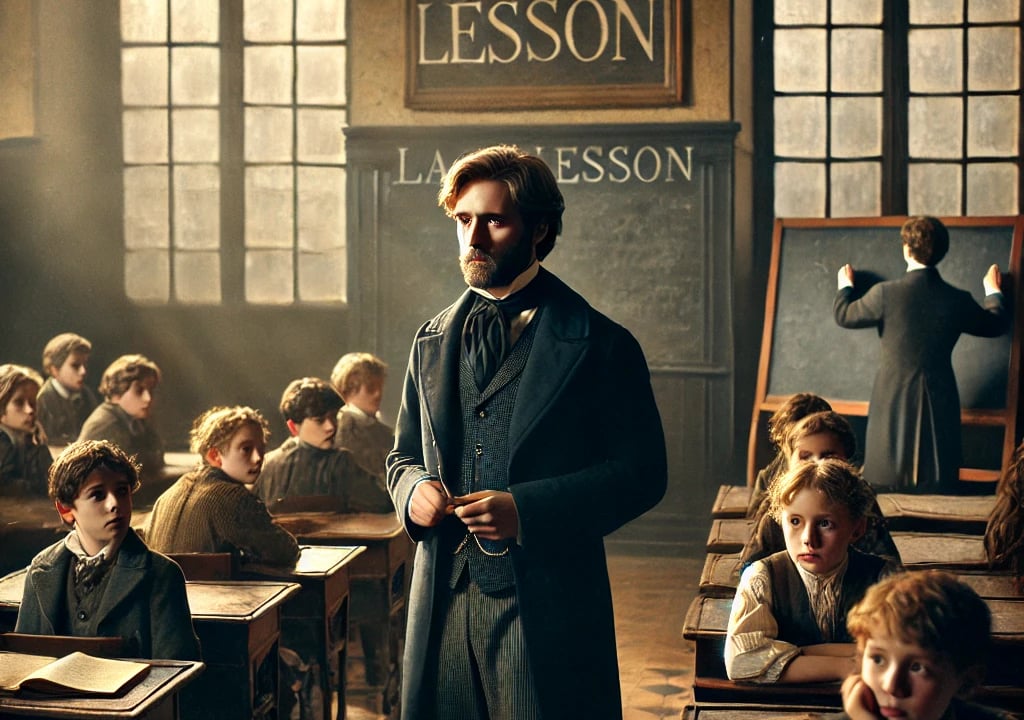
The Last Lesson is a story written by French writer and novelist Alphonse Daudet. It is set during the Franco-Prussian War (1870-1871), during which the French districts of Alsace and Lorraine were annexed to Prussia.
The story revolves around Franz, a young schoolboy who is not interested in going to school but prefers to idle his time by fishing or finding where the birds have laid their eggs. After reaching the school, he finds that a change has happened in the school in every respect. It was not clear to him the reason for this change. But when M.Hamel, his French teacher announces in the classroom that that was his last French lesson as the order has come from Berlin to teach only German in the school, Franz understands the reason and feels sorry for himself and his teacher. Along with Franz, the young and old students regret not giving importance to the French language and culture. The story dwells on the themes of patriotism, regret, loss of cultural identity, and the importance that the people should give to their land and language.
💡 The importance of language and identity shown here is also reflected in Indigo, where Gandhiji fights for the rights of farmers and dignity of people.
1. The Last Lesson
Acknowledgment: The questions and answers provided in this section are inspired by the themes and content of the NCERT English textbooks. For further reference, please consult the NCERT materials.
1.What is the background of the chapter 'The Last Lesson'?
Ans:- 'The Last Lesson' is set in the days of the Franco-Prussian war in which France was defeated by Prussia led by Bismarck and the French districts Alsace and Lorraine were passed into Prussian hands.
2.Why did Franz start late for school?
Ans:- Franz started late for school as he was afraid of the teacher's scolding and was not prepared with participles.
3.What were the three tempting things Franz felt were better than participles?
Ans:- Franz thought of spending the day out of doors as it was so warm and bright, the birds were chirping at the edge of the woods and in the open field back of the sawmill the Prussian soldiers were drilling.
4.What four bad news came out of the bulletin board?
Ans:- The lost battles, the draft, the orders of the commanding officer and the order to introduce the German language in the schools of Alsace and Lorraine with the complete ban on the French language.
5.What was the usual noise that was heard when the school began?
Ans:- The great bustle, the opening and closing of desks, lessons repeated in unison and the teacher's ruler rapping on the table.
6.Mention the unusual things Franz saw on that day.
Ans:- Franz saw that the classroom was still and quiet. His classmates were already in their places, M.Hamel was walking with his terrible iron ruler under his arm, and on the back benches sat the elderly village people.
7.What kind of dress was worn by M.Hamel?
Ans:- M.Hamel had worn a beautiful green coat, his frilled shirt and the little black silk cap, all embroidered.
8.When would M.Hamel wear that dress?
Ans:- M.Hamel would wear that dress on inspection and prize days.
9.What were the things that surprised Franz the most?
Ans:- Franz was surprised to see on the back benches the village people - old Hauser, the former mayor, the former postmaster and several others.
10.What did old Hauser bring?
Ans:- Old Hauser had brought an old primer, thumbed at the edges and held it open on his knees with his great spectacles lying across the pages.
11.What change did the order from Berlin make in the school on that day?
Ans:- The order from Berlin made it compulsory to teach only German in the schools of Alsace and Lorraine with the complete ban on the French language.
12.What would Franz do instead of learning his lessons?
Ans:- Instead of learning his lessons, Franz went in search of birds' eggs and sliding on the Saar.
13.How did Franz feel about the school and his teacher on that day?
Ans:- Franz felt sorry for not learning French when it was taught to him. He considered is books as a nuisance and when he realized that his teacher was going away he forgot all about his ruler and how cranky he was.
14.Why did the old men of the village sit in the class?
Ans:- The old men of the village sat in the class as they were sorry for not going to the school more, it was their way of thanking their master for his forty years of service and of showing their respect for the country that was theirs no more.
15.What was the great trouble with Alsace?
Ans:- The great trouble with Alsace was that she would put off learning till tomorrow.
16.Where would the parents prefer to send their children instead of sending them to school?
Ans:- The parents preferred to send their children to work on a farm or at the mills so as to have a little more money.
17.Why did M.Hamel blame himself?
Ans:- M.Hamel blamed himself because instead of teaching the children he would send them to water his flowers and whenever he wanted to go for fishing he would give them a holiday.
18.What did M.Hamel say about the French language?
Ans:- M.Hamel said that French is the most beautiful language in the world - the clearest, the most logical that we must guard it as it acts as a key to one's prison whenever anyone is enslaved.
19.How did M.Hamel's handwriting look like?
Ans:- M.Hamel's handwriting was beautiful and looked like little flags floating everywhere in the school room hung from the rod at the top of their desks.
20.How did everything that was taught seemed so easy for Franz?
Ans:-Franz was attentive during the class and the teacher taught the subject patiently.
21.What changes took place during M.Hamel's 40 years tenure?
Ans:- The desks and benches in the class had become smooth, the walnut trees had become taller and the hopvine had twined about the windows to the roof.
22.What happened when the church-clock struck twelve?
Ans:- When the church-clock struck twelve, the Angelus was recited, the trumpets of the Prussians returning from drill sounded under their windows and M.Hamel wrote on the board 'Vive La France.'
💡 If you are interested in stories about struggle and resilience, you should also read Lost Spring, which highlights the harsh realities of child labour.
The Last Lesson
– Alphonse Daudet
(These questions are given within the lesson or at the end of the lesson)
(Answer the following questions in 30 to 40 words each)
1. What was Franz expected to be prepared with for school that day?
Franz was expected to be prepared with the rules of participles for school that day. However, he had not studied the lesson at all and therefore feared that his teacher would scold him.
2. What did Franz notice that was unusual about the school that day?
Franz noticed that the school was unusually quiet that day. There was no noise from the classrooms, the teacher wore special clothes, and many villagers were sitting quietly on the back benches.
3. What had been put up on the bulletin board?
A notice had been put up on the bulletin board announcing that only German would be taught in the schools of Alsace and Lorraine. This order had come from Berlin after the Prussians conquered France imposing a complete ban on the French language.
4. What changes did the order from Berlin cause in school that day?
The order from Berlin made the day very unusual at school. It was the last French lesson. The German language was imposed. M. Hamel wore special clothes, villagers attended the class, and everyone felt sad and serious.
5. How did Franz's feelings about M. Hamel and school change?
Franz’s feelings about school and M. Hamel changed completely. He began to respect his teacher and felt sorry for not learning French seriously earlier. He suddenly realised the value of his language and lessons.
Practice Quiz on "The Last Lesson" (Multiple Choice Questions)
[Answers are given below]
Q1) What is the setting of the story "The Last Lesson"? (1 mark)
a) France during World War I
b) The fictional town of Hunsdorf
c) A German-occupied border region in France
d) A small town in India
Q2) Who is the main character of the story "The Last Lesson"? (1 mark)
a) Franz
b) Ernest
c) Monsieur Hamel
d) Herr Walter
Q3) What was the unexpected announcement made in Franz's school regarding language? (1 mark)
a) English would be the new language of instruction
b) Latin would be taught instead of German
c) This would be the last French lesson as German was to be imposed
d) Spanish would be introduced as a bilingual subject
Q4) How does Franz’s perspective on studying change in the story? (1 mark)
a) He decides to become a writer
b) He regrets not learning his lessons earlier
c) He chooses to skip school altogether
d) He plans to learn German first
Q5) What was the reaction of the villagers when they found out about the last lesson? (1 mark)
a) Indifference
b) Anger and protest
c) Sadness and nostalgia
d) Excitement for learning a new language
Q6) How did Monsieur Hamel react to the imposition of a new language? (1 mark)
a) He was happy and supportive
b) He resigned immediately
c) He was regretful but conducted his last lesson with dignity
d) He dismissed the class without teaching
Q7) Which aspect of the story highlights the theme of cultural loss? (1 mark)
a) Franz's excitement about a holiday
b) The new German teachers entering the school
c) The sorrow of the villagers losing their linguistic identity
d) The soldiers marching in the streets
Q8) What was the role of Monsieur Hamel in the classroom? (1 mark)
a) A strict disciplinarian with no emotions
b) A figure representing the loss of native language education
c) An indifferent outsider
d) A supervisor enforcing the new language policy
Q9) What does the "Last Lesson" symbolize in the broader context of the story? (1 mark)
a) The coming of modernization
b) The end of local customs
c) The political change of language imposition and cultural identity loss
d) The emergence of new technologies in education
Q10) What literary technique is most prominently used by the author to emphasize the themes? (1 mark)
a) Irony
b) Foreshadowing
c) Symbolism
d) Allegory
Q11) How has the village school been described when Franz reached there? (1 mark)
a) Bustling with students
b) Quiet like a Sunday morning
c) Full of music and laughter
d) Empty with echoes of joy
Q12) What evidence is shown that Franz didn't appreciate learning French before? (1 mark)
a) He always got top marks in French
b) He regularly skipped his French classes
c) He doodled during class rather than listening
d) He organized French study groups
Q13) Which historical event indirectly influenced the story's backdrop? (1 mark)
a) The French Revolution
b) The Franco-Prussian War
c) World War II
d) The signing of the Treaty of Versailles
Q14) How did the Prussia's regime introduced Germany's language to replace French? (1 mark)
a) By conducting German cultural events
b) Through aggressive military enforcement
c) By establishing German as the mandatory school language
d) By offering incentives for learning German
Q15) What did Monsieur Hamel wear which was out of his usual attire? (1 mark)
a) A casual dress
b) His formal suit
c) His special school uniform and green coat
d) Traditional German clothing
Q16) How did Franz relate to his surroundings during his 'last lesson'? (1 mark)
a) He felt detached and uninterested
b) Every object and sound held sentimental value
c) He ignored everything focusing on the future
d) He criticized the environment for its negativity
Q17)Why is language considered a key theme in "The Last Lesson"? (1 mark)
a) It is M. Hamel’s primary teaching subject.
b) It signifies cultural identity and lost autonomy.
c) It is used for an annual competition.
d) It gains importance only in literature.
Q18) Reflect the impact of sudden change in education system on Franz's community. (1 mark)
a) An increase in foreign students
b) A sense of freedom and new beginning
c) Confusion and increased absenteeism
d) A collective feeling of loss and mourning
Q19) How does the author Alphonse Daudet convey emotional depth in "The Last Lesson"? (1 mark)
a) Through lengthy narrations
b) By minimalistic description and focus on mundane activities
c) Capturing intricate emotional dialogues and reflective thoughts
d) Highlighting romantic relationships
Q20) What is the significant significance of 'The Last Lesson' that extends beyond personal loss? (1 mark)
a) Celebration of linguistic diversity
b) A critique of educational policies in general
c) A call to embrace global culture while respecting roots
d) Resistance to colonization and preservation of cultural heritage
Q21) What language were the church-clocks transformed to announce? (1 mark)
a) Latin
b) English
c) French
d) German
Q22) What did Franz think would happen to the pigeons? (1 mark)
a) They would start speaking German
b) They would be sold
c) They would die
d) They would migrate
Q23) Describe the metaphorical meaning of the term 'Turned to stone'. (1 mark)
a) Literal transformation
b) A state of absolute fear
c) Feeling emotionally paralyzed unable to express
d) Resolved determination
Q24) Why did Franz dread going to school on the day of 'The Last Lesson'? (1 mark)
a) He thought Monsieur Hamel would scold him for being late
b) He hadn't prepared for a test on participles
c) He wanted to play outside instead
d) He was upset with his classmates
Q25) In his final lesson, what quality of Monsieur Hamel is most highlighted? (1 mark)
a) His strictness
b) His sense of humor
c) His patriotic dedication to teaching and his language
d) His carelessness
Q26) What did Monsieur Hamel write on the board which struck a chord with Franz? (1 mark)
a) "Vive la Grenouille!"
b) "Le Patrie est en danger!"
c) "Vive La France!"
d) "Bonjour tout le monde!"
Q27) How did the people express their respect for Monsieur Hamel during the lesson? (1 mark)
a) By bringing him gifts and flowers
b) Listening to him with absolute attention and silence
c) Organizing a farewell party
d) Singing the national anthem
Q28) When does the atmosphere and attitude shift dramatically in the classroom? (1 mark)
a) When Franz finally answers a question correctly
b) When the bell at the church rings
c) At the announcement of the army's arrival
d) The beginning of the last lesson with the realisation of its gravity
Q29) How does "The Last Lesson" bring out the irony faced by native speakers under foreign rule? (1 mark)
a) It shows the ease of refusing to learn the foreign language
b) Emphasizes the urgency of language preservation when threatened
c) It highlights infinite educational opportunities
d) Natives quickly abandon their cultural identity
Q30) What primary emotion drives the narrative in "The Last Lesson"? (1 mark)
a) Anger
b) Desperation
c) Nostalgia and regret
d) Hope and cheerfulness
Answer Key
Q1 -c
Q2- a
Q3- c
Q4-b
Q5-c
Q6-c
Q7-c
Q8-b
Q9-c
Q10-c
Q11-b
Q12-c
Q13-b
Q14-c
Q15-c
Q16-b
Q17-b
Q18-d
Q19-c
Q20-d
Q21-d
Q22-a
Q23-c
Q24-b
Q25-c
Q26-c
Q27-b
Q28-d
Q29-b
Q30-c
'The Last Lesson' - Full Chapter Quiz - Test Your Understanding
Now that you have gone through the summary, important questions and practice MCQ's of The Last Lesson given above, it is time to test your understanding
Attempt the full chapter quiz given below and check how well you are prepared. Your score will be shown immediately after submission.
Enter your details and begin the quiz below.
📚 Continue Learning
If you found The Last Lesson meaningful, continue your learning journey:
👉 Read Lost Spring – A powerful story about child labour and lost childhood
👉 Explore Deep Water – A real-life story of courage and overcoming fear
👉 Discover Indigo – Gandhiji’s leadership and fight for justice
🎵 Poetry Connection:
👉 My Mother at Sixty-six – A touching poem on love and ageing
✍️ Practice Section:
👉 Letter Writing Format & Grammar
Want more practice?
Explore other chapters, notes, and quizzes on EduBeatsWorld to boost your English preparation.
contact@edubeatsworld.com
© 2024. All rights reserved.