
The Importance of STEM Education for Students
edubeatsworld.com
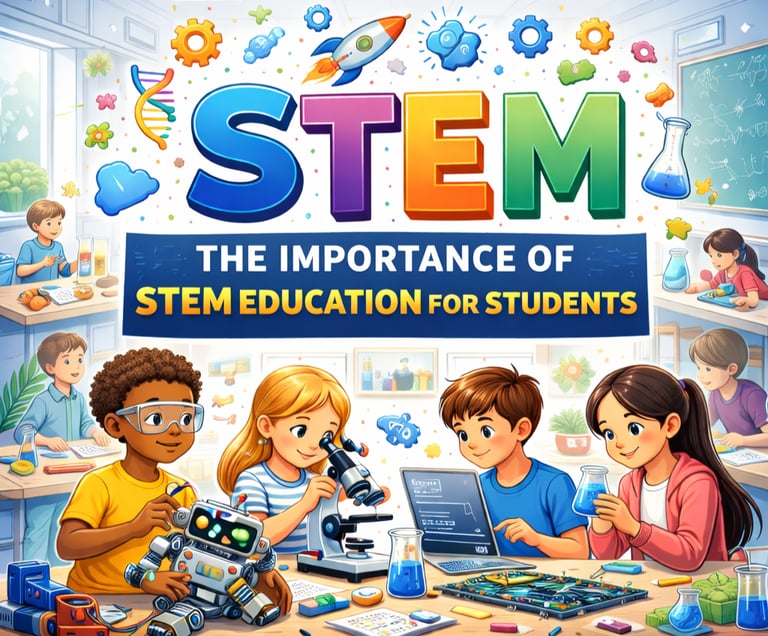
In the rapidly evolving landscape of the 21st century, traditional educational boundaries are being broken to accommodate a more integrated, dynamic and practical approach to learning. From Artificial Intelligence (AI) and the Internet of Things (IOT) to gene editing and renewable energy, the world is being transformed at a remarkable pace.
Central to this educational revolution is STEM – an acronym for Science, Technology, Engineering and Mathematics. More that just a group of four academic disciplines, STEM represents a fundamental shift in how we perceive knowledge and its application to the real world.
For today’s students, STEM education serves as a bridge between theoretical concepts and the complex challenges of a globalized society. Students lacking STEM literacy risk being left behind in an economy that increasingly rewards technical proficiency and analytical prowess. By democratizing access to high-level technical skills, STEM education provides students with a pathway to impactful careers. As we look towards a future challenged by global issues like climate change and public health threats, STEM educated students are not just learning to get jobs; they are becoming the innovators of tomorrow.


I. The Core Pillars: Defining the STEM Framework
To understand why STEM is so critical, it is essential to examine what each component contributes to a student’s development.
· Science (S): The Foundation of Inquiry
Science transcends memorization; it involves the Scientific method – a systematic approach to observing, forming hypotheses, and drawing evidence-based conclusions.
· Technology (T): The Tool of Modernity
Technology in STEM encompasses any human-made tool designed to solve a problem. In classrooms, this means shifting from being passive students of technology to becoming active creators who understand coding, data management, and digital systems.
· Engineering (E): The Art of Problem-solving
Engineering is the practical application of science and math for designing and building systems. Through the Engineering Design Process, students learn to define problems, imagine solutions, plan, create, and iterate, which destigmatizes failure and treats it as a crucial data point.
· Mathematics (M): The Universal Language
Mathematics enables students to quantify observations and ensure precision in designs.
II. Cognitive and Soft Skill Development
Beyond technical expertise, STEM education develops skills that are transferable across all domains.
· Critical Thinking and Logic: STEM challenges students to view problems from multiple angles and deconstruct complex issues into manageable parts.
· Collaboration and Teamwork: Success often depends on teamwork. STEM projects utilize group activities, requiring students to communicate ideas clearly and incorporate various perspectives.
· Resilience and Grit: In STEM, success rarely comes on the first try. STEM builds psychological resilience, teaching the students that mistakes are simply steps in the learning process.
III. Addressing Global Challenges
STEM education provides the toolkit necessary to tackle challenges like climate change, sustainable energy, and healthcare that lacks simple solutions.
· Climate Change: Mathematicians are needed to model climate patterns, scientists for sustainable biofuels and Engineers are needed to create better batteries.
· Healthcare: From mRNA vaccine development to AI- driven cancer detection, the medical field is not heavily reliant on STEM.
· Global Citizenship: Understanding the science behind global issues empowers students to be active citizens who contribute to global advancement.
IV. Economic Imperatives: Preparing for the 2030 Global Labor Market
The demand for STEM-literate workers is currently exceeding the global supply.
· Rapid Growth in STEM Roles: Employment in STEM fields is projected to grow by nearly 11% by 2033, far outpacing the 5% anticipated for non-STEM occupations.
· Higher Earning Potential: On average, salaries for STEM roles are double the national average for non-STEM careers.
· The Automation Frontier: As AI and automation assume routine tasks, remaining roles will require the high-level cognitive skills that STEM education provides. Machines can follow instructions but they cannot replicate the creative problem-solving needed in engineering and scientific research.


V. Prominent STEM Careers: Growth and Opportunity
As the global economy shifts toward automation, sustainability, and data-riven decision-making, the following STEM careers are projected to see the highest demand between 2026and 2034. These roles offer strong growth prospects and high earning potential, often commanding six-figure median salaries.
· Artificial Intelligence & Data Science AI & Machine Learning Engineers: Develop algorithms for autonomous vehicles and diagnostic tools.
· Data Scientists: Use statistics and programming to gain insights from large data sets. Global Statistics project a 34% growth rate for this role through 2034.
· Statisticians & Actuaries: Apply math to quantify risk in finance and insurance with actuary roles expected to grow by 22%.
· Cybersecurity & Information Technology Information Security Analysts: Design security protocols to protect networks from cyber threats with a projected 29% growth and a median salary of approximately $124,910.
· Cloud Computing Engineers: Manage scalable digital infrastructure crucial for modern businesses.
· Software Developers: Build applications and underlying systems with a projected 15-17% growth.
· Renewable Energy & Sustainability Wind Turbine Service Technicians: Anticipated 50% growth, making it the fastest growing occupation.
· Solar Photovoltaic Installers: Ranked second for growth at 42% due to expanding solar energy adoption.
· Environmental Engineers: Develop solutions for pollution control and climate change mitigation.
· Healthcare & Biotechnology Nurse Practitioners (NPs): Projected to grow by 40% to fill primary care shortages.
· Biomedical Engineers: Create artificial organs, prosthetics, and advanced medical devices.
· Epidemiologists: Investigate disease patterns to enhance public health policies, with a projected 16% growth.
· Specialized Engineering Aerospace Engineers: Focus on next-generation flight and space innovations, with a 6% growth through 2034.
· Robotics Engineers: Design robotic systems for diverse applications in manufacturing, healthcare, and beyond.
· Industrial Engineers: Optimize complex processes for improved productivity and sustainability.
VI. Diversity and Inclusion: Closing the Opportunity Gap
A crucial aspect of modern STEM education is its focus on inclusivity. STEM initiatives now aim to bridge the gender and diversity gap, recognizing that diverse teams yield richer perspectives and better problem-solving. Effective programs in schools break down stereotypes, ensuring that every student has an equal opportunity to pursue high-tech careers, irrespective of their social status or ethnic background.
Conclusion: Investing in the Architects of Tomorrow
The importance of STEM education for students extends far beyond the classroom; it fosters a generation of thinkers who are curious, capable, and compassionate. By providing students with the ‘mental software’ to navigate an increasingly complex world, we ensure that they are not just ready for the future – but they are equipped to shape it.
The importance of STEM education for students extends far beyond the classroom; it fosters a generation of thinkers who are curious, capable, and compassionate. By providing students with the "mental software" to navigate an increasingly complex world, we ensure they are not just ready for the future—they are equipped to shape it.
contact@edubeatsworld.com
© 2024. All rights reserved.