
IELTS 16 May 2026 Prediction: Writing Task, Speaking Cue Cards + Band 9 Samples
edubeatsworld.com
5/13/2026
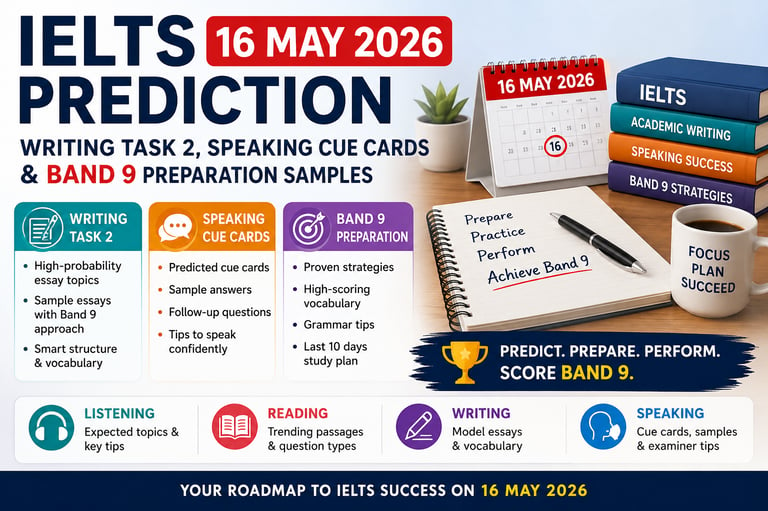
Preparing for the IELTS exam can feel overwhelming, especially when students are unsure about the type of questions they may face in the actual test. The IELTS Academic and General Training exams scheduled for 16 May 2026 are expected to follow several topic trends that have repeatedly appeared in recent months. Based on question patterns from January to May 2026, many educators and IELTS analysts believe that themes such as technology, education, environment, work-life balance, and social change may dominate the exam.
While predictions are never guaranteed, understanding current trends helps candidates prepare more strategically. Instead of studying random topics, students can focus on high-probability areas and improve their confidence before the examination day.
1. IELTS Writing Task 2 Predictions – Samples - for 16 May 2026
Writing Task 2 continues to be one of the most challenging sections for many IELTS candidates because it tests grammar, vocabulary, critical thinking, and organization together. Recent exam patterns show that IELTS is increasingly focusing on modern issues connected to environment, technology, work-life balance, Government spending, lifestyle changes, and education.
AI Replacing Teachers in Schools
One of the strongest predicted topics for May 2026 is the growing influence of artificial intelligence in education. Candidates may be asked whether AI can replace teachers in the future or whether human teachers will always remain essential.
This topic has become popular because educational technology is rapidly expanding worldwide. Many schools now use AI-based applications, online assessments, and personalized learning systems. However, IELTS essays are not only about technology; they also test whether students can present balanced arguments with examples and clear reasoning.
A strong response should explain that although AI can support learning by providing quick information and personalized practice, human teachers still play an irreplaceable role in emotional support, motivation, classroom management, and moral guidance. Students can discuss how teachers understand emotions, encourage shy learners, and adapt lessons according to classroom situations — something technology still struggles to achieve fully.
Candidates can strengthen their essays by mentioning real-life examples such as smart classrooms, online learning during the pandemic, or India’s NEP 2020 educational reforms that encourage innovative teaching methods.
Work From Home: Advantages and Disadvantages
Another likely topic is remote work or work-from-home culture. Since the pandemic years, this subject has appeared repeatedly in IELTS examinations because it reflects a major global shift in professional life.
A well-developed essay should not simply list advantages and disadvantages in bullet style. Instead, candidates should explain how remote work affects both employees and companies in practical ways.
For employees, working from home often saves commuting time, reduces travel expenses, and allows better family balance. Many workers also feel more comfortable and productive in their personal environment. However, there are disadvantages too. Some people experience loneliness, lack of social interaction, or difficulty separating professional and personal life.
From the company’s perspective, remote work may reduce office expenses and increase flexibility, but businesses may also struggle with communication gaps, reduced teamwork, and employee monitoring challenges.
To achieve a higher band score, students should maintain balance in their arguments and include examples from modern workplaces or multinational companies adopting hybrid work models.
Traffic Congestion in Major Cities
Traffic congestion remains one of the most common IELTS topics because it affects cities across the world. Candidates may receive a problem-solution essay asking about the causes and possible solutions to increasing traffic.
Instead of writing very short explanations, students should connect traffic congestion with broader social and environmental impacts. Heavy traffic increases pollution, wastes fuel, raises stress levels, and reduces productivity because people spend long hours commuting.
A high-quality essay should explore practical solutions such as improving public transportation systems, encouraging carpooling, expanding metro networks, promoting remote work opportunities, and constructing better urban infrastructure.
Students can refer to examples from cities like Mumbai, Delhi, London, or Singapore to make their essays more realistic and informative.
Gap Year Before University
The concept of students taking a gap year before university has become increasingly popular worldwide. IELTS examiners may ask whether this is a positive or negative development.
A mature response should discuss both sides before presenting a final opinion. Taking a gap year can help students gain life experience, improve communication skills, travel, volunteer, or prepare mentally for higher education. Many students return to academics with greater focus and maturity after a break.
However, there can also be disadvantages. Some students lose their study habits, become distracted, or delay their academic goals for too long. Financial limitations may also prevent productive use of the gap year.
Candidates should avoid extreme opinions and instead present a balanced, thoughtful discussion supported by examples.
2. IELTS Speaking Part 2 Cue Cards Predictions for 16 May 2026
Part 1 Introduction Questions: Work/Study, Hometown, Music, Social Media. You must keep 2 lined answers ready.
The Speaking test often worries students because they must respond naturally under time pressure. However, recent IELTS trends show that many cue cards revolve around everyday experiences, technology, decisions, and personal memories.
Part 2 High-Probability Cue Cards
Describe a Piece of Technology You Find Difficult to Use
Technology-related cue cards are expected to remain highly important in 2026. Candidates may be asked to describe a gadget, software application, or digital platform they struggle to use.
Instead of giving a very technical explanation, students should focus on personal experience. For example, a candidate might describe difficulty using a smartwatch, advanced photo-editing software, DigiLocker, or even certain AI tools.
A strong answer should explain:
what the technology is,
why it is difficult,
how the candidate felt while using it,
and whether they are improving gradually.
Natural storytelling and emotional expression often make speaking answers sound more authentic and human.
Describe a Time You Helped Someone
This cue card tests emotional expression and personal communication skills. Candidates should narrate a real or believable situation in detail rather than giving short factual answers.
Students can talk about helping a friend prepare for exams, assisting a family member during illness, supporting classmates with studies, or helping someone during travel.
Good speaking responses include emotions, reactions, and reflections. Instead of merely saying “I helped my friend in studies,” candidates should explain why the help was important, what challenges existed, and how both people felt afterward.
Describe a Crowded Place You Visited
Crowded place cue cards frequently appear because they connect naturally to follow-up discussions about urbanization, tourism, and public management.
Candidates may describe a market, festival, railway station, concert, shopping mall, or religious gathering. Indian students may mention places such as Kumbh Mela, Mumbai local stations, Sarojini Market, or even an IELTS exam center.
To make the answer engaging, candidates should include sensory details such as noise, atmosphere, decorations, movement, and emotions experienced in the place.
Describe an Important Decision You Made
This topic allows candidates to demonstrate maturity and reflective thinking. Students often speak about educational choices, career decisions, relocation, or selecting a stream after school.
A good response explains:
· what decision was made,
· why it was difficult,
· who influenced the decision,
· and what the final outcome was.
Examiners usually appreciate answers that sound genuine and personal rather than memorized.
3. IELTS Listening and Reading 16 May 2026: Expected Trends
The Listening and Reading sections continue to follow familiar structures, but students often lose marks due to carelessness rather than lack of knowledge.
Listening Section Expectations
In Listening Section 1, candidates are likely to encounter form-filling tasks involving hotel bookings, university registrations, or club memberships. Students should practice spelling carefully because incorrect spelling leads to lost marks even if the answer idea is correct.
Section 4 may include academic lectures on climate change, renewable energy, or scientific research. Candidates should focus on identifying keywords and understanding paraphrased information instead of trying to write every word.
Reading Section Expectations
Reading passages may include informational guides, scientific discussions, or historical arguments. Many experts predict passages connected to education, environment, or psychology.
One likely topic area is the impact of music on the brain, often connected with concepts like the Mozart Effect. Candidates should practice skimming for main ideas and scanning for details quickly.
True/False/Not Given questions continue to trouble students because they require precise understanding of meaning. Students should avoid assumptions and rely only on the information directly stated in the passage.
Last 10-Day Preparation Strategy
The final days before IELTS should focus on improving consistency rather than learning hundreds of new words.
Build Exam Discipline
Students should begin solving full-length mock tests under real exam timing conditions. Practicing at the same hour as the actual exam helps the brain adjust to the schedule and improves concentration.
Listening and Reading practice should focus on identifying repeated mistakes. Many students repeatedly lose marks in spelling, plural forms, or misunderstanding instructions.
Improve Speaking Confidence
For Speaking preparation, recording answers can be extremely useful. Candidates often notice pronunciation mistakes, repetition, or unnatural pauses only when they hear themselves.
Students should avoid memorizing artificial answers because examiners can easily recognize rehearsed responses. Natural fluency and clear communication matter more than complicated vocabulary.
Practice Writing Smartly
Instead of writing many essays quickly, students should focus on writing fewer essays with better structure and vocabulary. Strong introductions, coherent body paragraphs, and relevant examples are more important than decorative language.
Complex sentences should be used naturally. Overusing difficult grammar often creates mistakes that reduce the band score.
4. Band 9 Vocabulary for Common IELTS Topics
Vocabulary improvement should focus on useful academic expressions rather than rare words.
For technology essays, students can use terms like ubiquitous technology, digital transformation, or artificial intelligence systems.
For environmental topics, phrases such as environmental degradation, renewable energy, and sustainable development sound more academic and precise.
In education essays, expressions like holistic development, critical thinking skills, and student-centered learning can improve lexical resource scores.
However, vocabulary should always sound natural within the sentence context.
FAQs: IELTS 16 May 2026
1. Is 16 May 2026 IELTS Academic or GT?
Both. IDP & British Council conduct Academic + General Training on same date. Check your TRF.
2. Will 16 May paper be harder than April?
Difficulty is standardized. But May papers have 60% chance of repeating March-April topics. Easier if you prep predictions.
3. Can I change IDP to British Council now?
No. After booking, no transfer. But syllabus + difficulty = same. Only Speaking examiner differs.
4. What if I get 6.5 but need 7.0?
Book next test: 23 May or 6 June 2026. Or apply for EOR – revaluation. Cost ₹8,475. Takes 21 days.
5. Are predictions 100% accurate?
No. IELTS never repeats exact Qs. But themes repeat. 80% of 9 May 2026 students got “technology” essay we predicted.
Final Thoughts
The IELTS exam on 16 May 2026 is expected to focus heavily on modern social and technological issues. Students who prepare intelligently by understanding topic trends, improving time management, and practicing realistic answers will perform far better than those who rely only on memorization.
Predictions should be treated as preparation tools rather than guaranteed questions. The goal is not to memorize essays but to become comfortable discussing likely themes confidently and naturally.
Consistent practice, calm preparation, and strong understanding of exam patterns can significantly improve performance in all four sections of IELTS.
Disclaimer: IELTS topics are predicted based on past paper analysis and trends from Jan-May 2026. IDP and British Council do not release questions in advance. These predictions are not guaranteed. Use them for practice only. For official info, visit ielts.org or ieltsidpindia.com. Test dates and formats may change. Edubeatsworld.com is not affiliated with IDP, British Council, or Cambridge.
contact@edubeatsworld.com
© 2024. All rights reserved.