
CBSE Two Board Exam Policy 2026: New Rules Explained
edubeatsworld.com
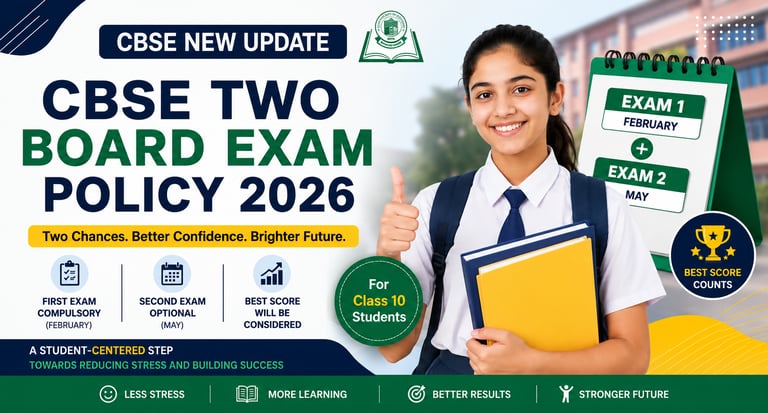

The Central Board of Secondary Education (CBSE) has introduced a major change in the Indian Education System by announcing the Two Board Exam Policy for Class 10 students from 2026 onwards. This reform has been introduced in line with the recommendations of the National Education Policy (NEP) 2020 and aims to reduce stress, increase flexibility, and give students better opportunities to improve their academic performance.
For decades, students faced immense pressure because a single board examination often determined their future academic path. Many students struggled with anxiety, fear of failure, and the burden of performing perfectly in one attempt. The new CBSE policy seeks to change this traditional system by allowing students a second opportunity within the same academic year.
This article explains the CBSE Two Board Exam Policy in detail, including its structure, benefits, challenges, examination pattern, impact on students, and how schools and parents can prepare for this transformation.
What is the CBSE Two Board Exam Policy?
The CBSE Two Board Exam Policy means that students of Class 10 will now have the opportunity to appear for board examinations twice in one academic year.
Under this system:
The first examination will be compulsory.
The second examination will be optional.
Students can improve marks in selected subjects.
The best score out of the two attempts will be considered for the final result.
This policy aims to create a more student-friendly examination environment while reducing the fear associated with one-time high-stakes exams.
Why Did CBSE Introduce This Policy?
The policy is largely inspired by the recommendations of the National Education Policy (NEP) 2020. The NEP emphasized reducing exam-related pressure and promoting holistic learning rather than rote memorization.
Major Reasons Behind the Policy
1. Reducing Examination Stress
Students often experience tremendous stress before board exams. A second attempt gives psychological relief and reduces fear.
2. Encouraging Better Learning
Students can focus on understanding concepts rather than simply memorizing content for one final exam.
3. Providing Flexibility
Students who fall sick, face emergencies, or perform poorly due to anxiety get another opportunity.
4. Improving Academic Performance
Students can analyze their mistakes after the first attempt and improve their scores in the second examination.
5. Aligning with Global Education Practices
Many countries already provide flexible examination systems with multiple attempts. CBSE is moving towards a more modern educational structure.
How Will the Two-Exam System Work?
Although CBSE may continue refining the details, the broad structure of the policy is expected to work as follows:
First Board Examination
Conducted around February.
Mandatory for all students.
Covers the full syllabus.
Serves as the primary board examination.
Second Board Examination
Conducted around May.
Optional in nature.
Students may choose selected subjects for improvement.
Best marks among both attempts will be counted
Key Features of the CBSE Two Board Exam Policy
Flexible Improvement Opportunity
Students can improve their scores without waiting for an entire academic year.
Student-Friendly Assessment
The system becomes less rigid and more supportive.
Reduced Fear of Failure
Students know they have another opportunity if things do not go well initially.
Better Mental Health Support
The policy may reduce emotional pressure and anxiety among students.
Encouragement for Conceptual Learning
Students can focus more on understanding and application rather than last-minute memorization.
Benefits of the Two Board Exam Policy
The new policy offers several advantages for students, parents, and schools.
Benefits for Students
1. Lower Stress Levels
Students no longer need to believe that one examination determines everything.
2. Second Chance to Improve
A poor performance in one subject does not permanently affect the final result.
3. Greater Confidence
Students may enter the examination hall with less fear and more confidence.
4. Better Time Management
Students can identify weak subjects after the first attempt and prepare accordingly.
5. Reduced Fear of Illness or Emergencies
Unexpected situations during exams will not completely ruin academic performance.
Benefits for Parents
1. Less Academic Pressure at Home
Parents may become less anxious knowing their child has another opportunity.
2. Improved Emotional Support
Families can focus more on learning rather than excessive marks pressure.
3. Better Student Well-being
Parents may notice improvements in their child’s emotional health and confidence.
Benefits for Schools
1. Encourages Better Teaching Methods
Schools may focus more on conceptual understanding.
2. Reduced Pressure on Result Day
Schools may experience less stress related to board results.
3. More Continuous Academic Support
Teachers can guide students even after the first examination.
Possible Challenges of the Policy
Although the policy has many benefits, it also comes with certain challenges.
Challenges for Students
1. Extended Examination Period
Students may remain connected to exam preparation for a longer time.
2. Overconfidence
Some students may become careless during the first attempt thinking they can improve later.
3. Time Pressure
Balancing school studies and preparation for the second exam may become difficult.
Challenges for Schools and Teachers
1. Increased Administrative Work
Schools may need to manage two examination cycles.
2. Academic Calendar Adjustments
Schedules for admissions and next academic sessions may require changes.
3. Additional Evaluation Work
Teachers may need to handle more answer paper evaluations.
Impact on Competitive Exams
One important question students ask is whether this policy will affect competitive examinations.
Currently, most entrance examinations such as:
JEE
NEET
CUET
Mainly consider Class 12 performance and entrance scores. Therefore, the direct impact on competitive exams may be limited.
However, the policy may help students develop:
Better exam confidence
Improved time management
Stronger conceptual understanding
These skills can indirectly help in future competitive examinations.
How Students Should Prepare Under the New Policy
The Two-Exam system should not encourage students to become relaxed or careless. Instead, students should continue preparing seriously from the beginning.
Smart Preparation Strategies
Study Consistently
Avoid depending entirely on the second attempt.
Focus on Understanding Concepts
Conceptual clarity is more important than memorization.
Analyze Mistakes
After the first attempt, identify weak areas and improve them.
Practice Sample Papers
Regular practice improves speed and accuracy.
Maintain Mental Balance
Students should focus on health, sleep, and emotional well-being during preparation.
Role of Parents in the New System
Parents play a very important role in ensuring students use this opportunity wisely.
Parents Should:
Encourage consistent study habits.
Avoid unnecessary comparison with other students.
Support emotional well-being.
Help children maintain confidence.
Promote balanced routines and healthy lifestyles.
Role of Teachers and Schools
Teachers and schools will become even more important under this flexible system.
Schools May Need To:
Provide counseling support.
Conduct regular assessments.
Help students identify weaknesses.
Offer remedial classes.
Guide students in managing examination stress.
Will This Policy Change the Indian Education System?
The CBSE Two Board Exam Policy may become a turning point in Indian Education.
For many years, the Indian system has often been criticized for:
Rote learning
Excessive pressure
Marks-oriented education
Lack of flexibility
This reform may gradually encourage:
Skill-based learning
Conceptual understanding
Student well-being
Flexible assessment systems
If implemented effectively, the policy could create a healthier academic environment for millions of students.
Important Things Students Must Remember
Even though there are two opportunities, students should still treat the first exam seriously.
Key Reminders
Do not depend entirely on the second attempt.
Prepare consistently throughout the year.
Use the second exam only as an improvement opportunity
Focus on learning rather than memorization.
Maintain discipline and time management.
Future Possibilities
Educational experts believe this policy may lead to more reforms in the future.
Possible future developments include:
Semester-based assessments
Modular examinations
More skill-oriented testing
Digital evaluation systems
Greater flexibility in subject choices
CBSE may gradually modernize examinations further to match global educational standards.
Conclusion
The CBSE Two Board Exam Policy 2026 represents a major shift towards a more flexible and student-friendly education system in India. By providing students with two opportunities to perform, CBSE aims to reduce stress, encourage conceptual learning, and improve overall academic confidence.
While the policy offers many benefits, its success will depend on how students, parents, schools, and teachers adapt to the new system. Students must continue studying sincerely and avoid becoming overdependent on the second attempt.
If implemented properly, this reform could create a healthier and more balanced academic environment where learning becomes more important than fear, pressure, and one-time performance.
The CBSE Two Board Exam Policy is not just a change in examination scheduling — it is a step towards transforming the future of Indian education.
contact@edubeatsworld.com
© 2024. All rights reserved.